
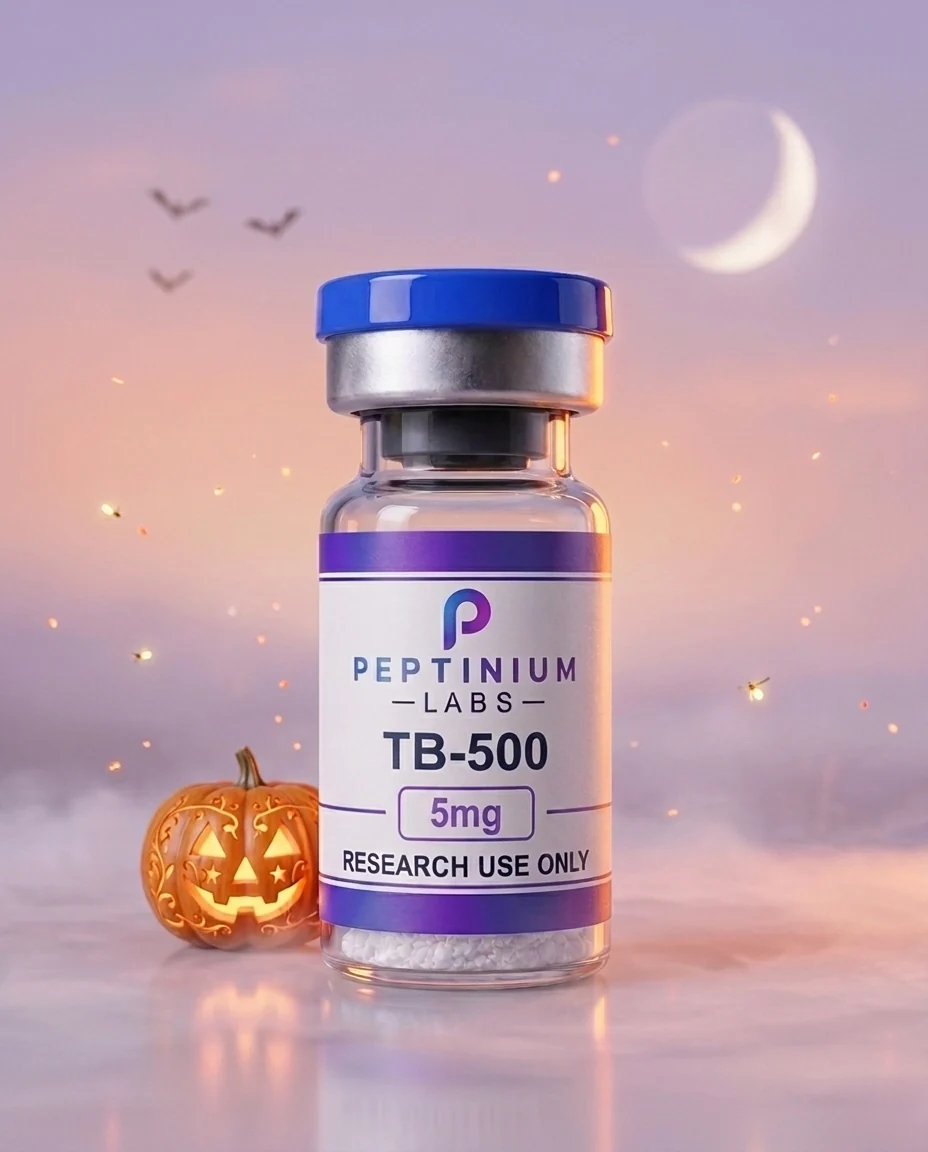
Cap colour may vary by batch.
For research use only
TB-500
Synthetic fragment of Thymosin β4 — in vitro study tool for cell migration and angiogenesis.
DosagePurity ≥ 99.0% (HPLC)
€64.00per 5 mg vial
i.e. €12.80 per mg
QuantityHalloween 2 + 1
3 vials: the cheapest item is free at checkout. Estimate for this product alone; the discount is applied at payment, across your whole cart.
Complete your orderOptional
In stock
Shipped within 24 business hours from France, in neutral packaging.
Free shipping from €249. Minimum order €80; delivery options and fees shown on the payment page.
Card, Apple Pay or crypto (USDC, USDT, Bitcoin).

Halloween: 2 + 1 free sitewide · buy 3 items, the cheapest one is free.
Buy 3 items and the cheapest one is free: peptides, packs, pens or accessories, everything counts, and each unit counts as one item. 6 items = 2 free, 9 = 3 free (3 maximum per order). Offer not combinable with promo codes, applied automatically at checkout. Until 31 October inclusive.
A question about this product?
Research Use Only — Laboratory use exclusively. Not intended for veterinary, diagnostic or therapeutic use. No indication for in vivo use. To be handled exclusively by qualified personnel.
Literature
What the literature describes
TB-500 reproduces the active sequence of Thymosin β4 (Tβ4), an endogenous peptide involved in regulating the actin cytoskeleton. Studies (PMID 14500546, PMID 11311852) describe sequestration of G-actin, modulating F-actin polymerization and promoting cell migration (keratinocytes, endothelial cells, stem cells). At the angiogenic level, TB-500 stimulates capillary tube formation by HUVECs and activates the PINCH-ILK-α-parvin pathway. Preclinical models also describe modulation of pro-inflammatory cytokines. No direct hormonal effect has been reported. These data come from the scientific literature and are provided strictly for informational purposes in a research context. This product is not intended for veterinary, diagnostic or therapeutic use and is not recommended for any use outside a scientific, professional and research setting. [1][2]
- Research background
- Synthetic peptide corresponding to an active fragment of Thymosin β4, used for the in vitro study of G-actin sequestration.
- Reconstitution (lab)
- Sterile bacteriostatic water. Dilution calculator
Chemical identity
What the vial contains
Reference data for the compound. Measured values appear on the Janoshik certificate, when published.
- Research name
- TB-500
- CAS No.
- 77591-33-4
- Molecular formula
- C212H350N56O78S
- Molecular weight
- 4963.4 g/mol
- Specified purity
- ≥ 99.0% (HPLC)
- Vial content
- 5 mg
- Storage
- Lyophilized: refrigerated (2–8 °C) from receipt, protected from light, or at −20 °C for long-term storage; it tolerates a few days of shipping at room temperature with no expected degradation. Reconstituted: refrigerated (2–8 °C).
- Database
- PubChem
Independent analysis
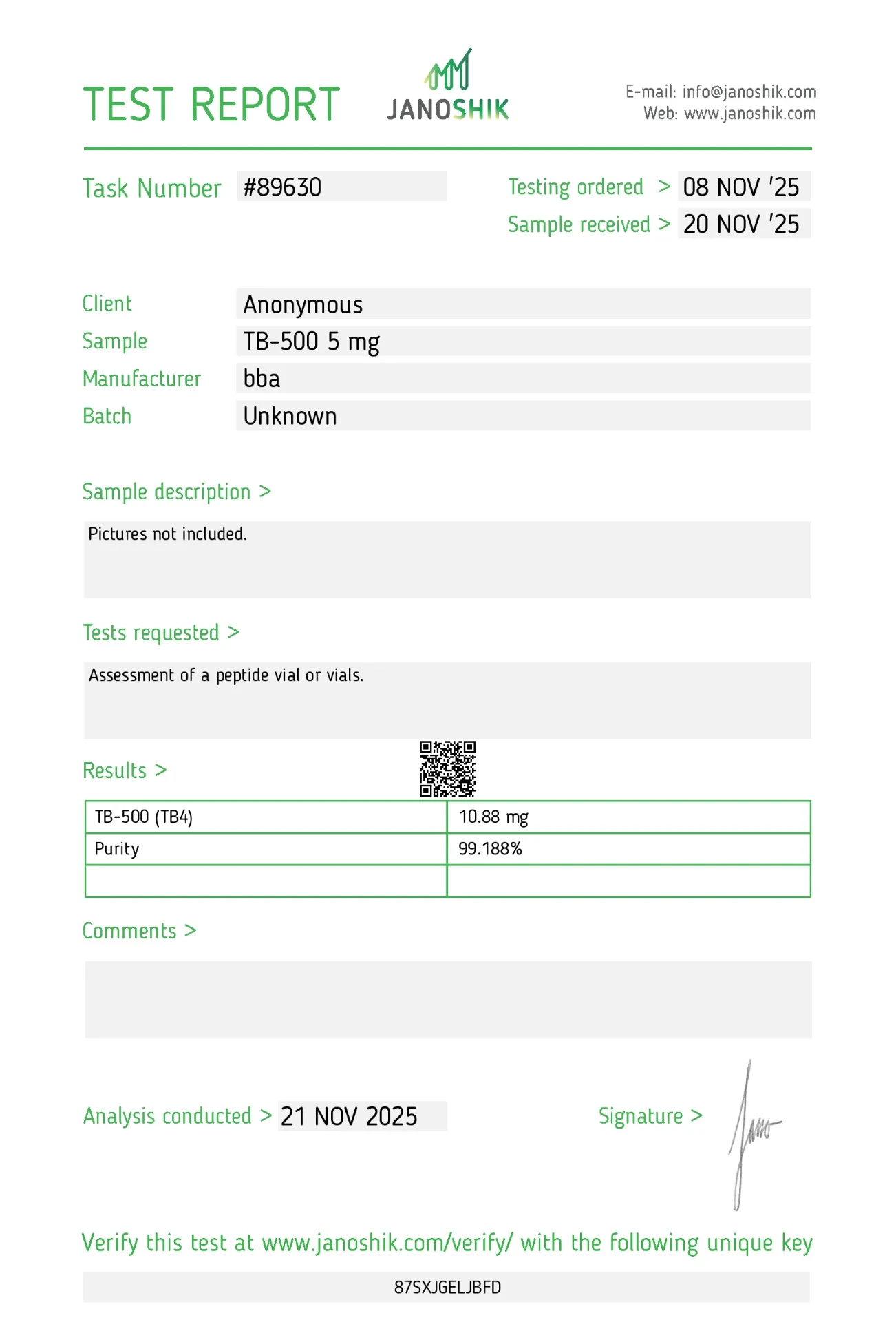
Certificate for 5 mg
Report from Janoshik Analytical, an independent laboratory, for this exact dosage. The data below are taken from the report.
Janoshik certificate for this dosageCommissioned by: third-party report
- Purity
- 99.188% (10.88 mg)
- Janoshik task
- #89630
- Tested
- 21/11/2025
Questions
Frequently asked questions
What does a vial of TB-500 contain?
Each vial contains lyophilised TB-500, available in 5 mg. Purity ≥ 99.0% (HPLC), tested by an independent laboratory.
How can I check the purity of TB-500?
The Janoshik Analytical (independent laboratory) certificates we hold are shown on this page for the matching dosage and can be verified directly on the laboratory's website. For a dosage without a published certificate, testing is in progress or available on request.
How should TB-500 be stored?
Lyophilized: refrigerated (2–8 °C) from receipt, protected from light, or at −20 °C for long-term storage; it tolerates a few days of shipping at room temperature with no expected degradation. Reconstituted: refrigerated (2–8 °C).
How is TB-500 reconstituted in the laboratory?
Sterile bacteriostatic water. The site's dilution calculator helps prepare the desired concentration.
Is TB-500 intended for human use?
No. TB-500 is a research reagent (RUO) intended exclusively for in vitro laboratory research. It is not intended for human or veterinary use, nor for diagnosing, preventing or treating any disease.
References
Cited sources
- [1]PubMedPMID 10469335PubMed · 10469335View on PubMed
- [2]PubMedPMID 17600280PubMed · 17600280View on PubMed
Blog
Related guides
KLOW: the scientific rationale behind this four-peptide repair blendGHK-Cu, BPC-157, TB-500 and KPV combined in a single protocol: why the literature studies these four mechanisms as complementary rather than redundant.Read the articleBPC-157 and TB-500: what preclinical research literature says about tissue repairAngiogenesis, cell migration, rodent models: what the published preclinical literature documents on BPC-157 and TB-500 — two peptides frequently studied together.Read the articleResearch peptides in France: the 2026 guideRUO framework, choosing a supplier, HPLC purity, Janoshik certificates of analysis, storage and reconstitution: the essentials on research peptides in France.Read the article
Same family
Related products
Customer reviews
What our customers say
No review yet for this product.
Leave a review
Sign in to your account to leave a review.
Sign in