
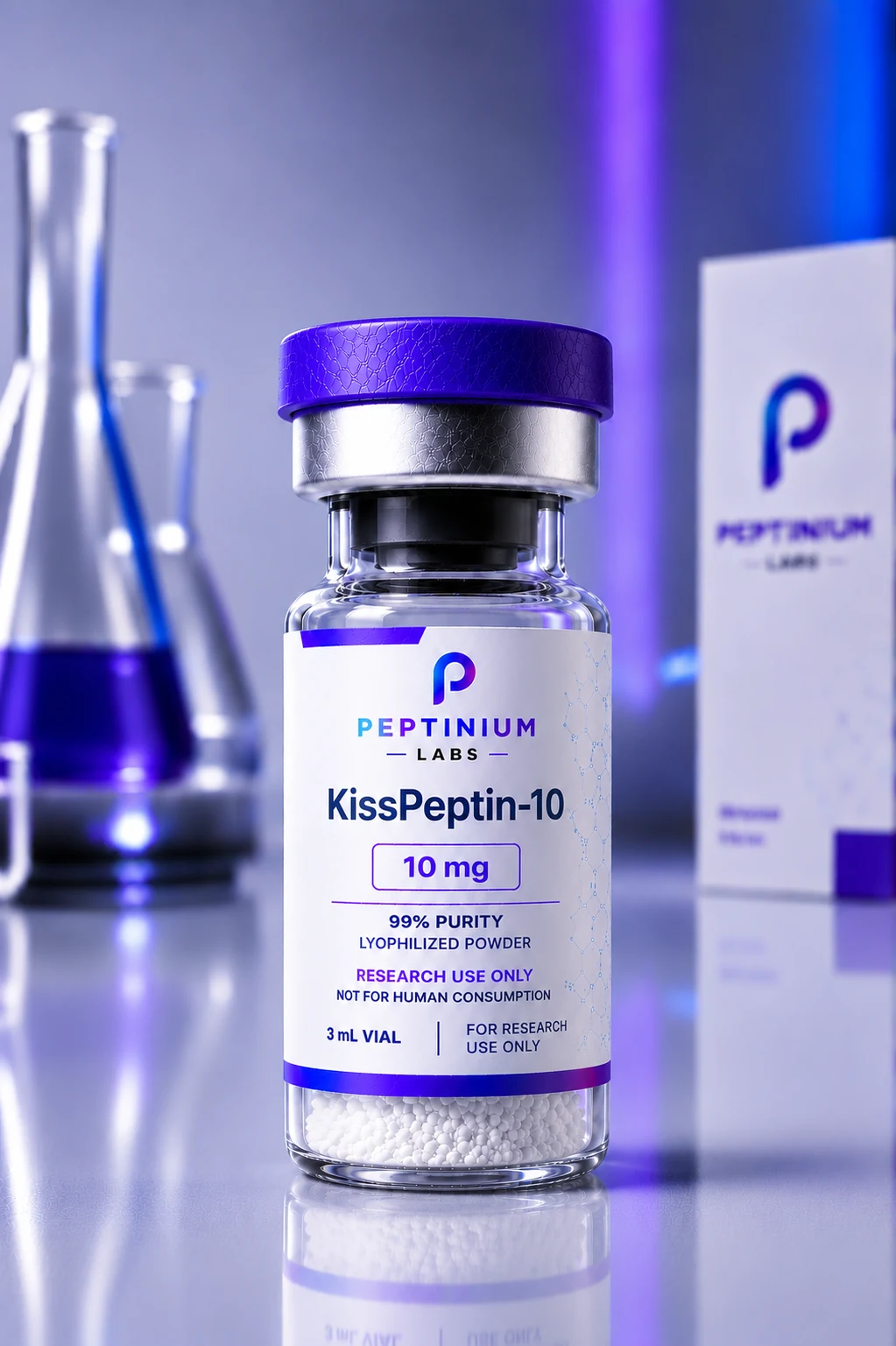
KissPeptin-10
Evidence score · 4 ref. PubMedLyophilized research compound · CAS 374675-21-5
Endogenous KISS1 decapeptide — in vitro research reagent for the study of the hypothalamic-pituitary-gonadal axis.
Not intended for veterinary, diagnostic or therapeutic use. No indication for in vivo use. To be handled exclusively by qualified personnel.
- CAS No.
- 374675-21-5
- Molecular weight
- 1217.48 g/mol
- Molecular formula
- C59H84N16O14S
Effects documented in the literature
KissPeptin-10 is the active decapeptide fragment of the KISS1 protein (human amino acids 112-121: Tyr-Asn-Trp-Asn-Ser-Phe-Gly-Leu-Arg-Phe-NH2). It is the main endogenous agonist of the G protein-coupled receptor GPR54 (KISS1R). Studies (PMID 16410315, 16439435) established that the KISS1/GPR54 pathway is the central physiological switch activating the reproductive axis: it triggers pulsatile GnRH secretion by hypothalamic neurons, downstream stimulating LH and FSH from the pituitary. At the cellular level, KissPeptin-10 activates PLCβ, increases IP3 and intracellular calcium, and induces c-Fos expression in GnRH neurons. Preclinical work also describes a role in the regulation of puberty, energy metabolism, and bone mass via indirect effects on the GH/IGF-1 axis and corticotropin. No direct activity on GLP-1, GIP, or GH receptors has been reported. These data come from the scientific literature and are provided strictly for informational purposes in a research context. This product is not intended for veterinary, diagnostic or therapeutic use and is not recommended for any use outside a scientific, professional and research setting. [1][2][3][4]
Background, storage, reconstitution
- Research background
- Peptide derived from the KISS1 protein used as a reference ligand to characterize the GPR54 (KISS1R) receptor and GnRH secretion in hypothalamic cellular models.
- Storage
- Lyophilized: −20 °C, protected from light. Reconstituted: 2–8 °C, ≤ 28 days.
- Reconstitution (lab)
- Reconstitute with sterile bacteriostatic water. Clear, colorless solution.→ Dilution calculator
PubMed references
- View on PubMed →[1] PubMedPMID 16410315
- View on PubMed →[2] PubMedPMID 16439435
- View on PubMed →[3] PubMedPMID 18202148
- View on PubMed →[4] PubMedPMID 21653835
What our customers say
No review yet for this product.
Leave a review
Sign in to your account to leave a review.
Sign in