
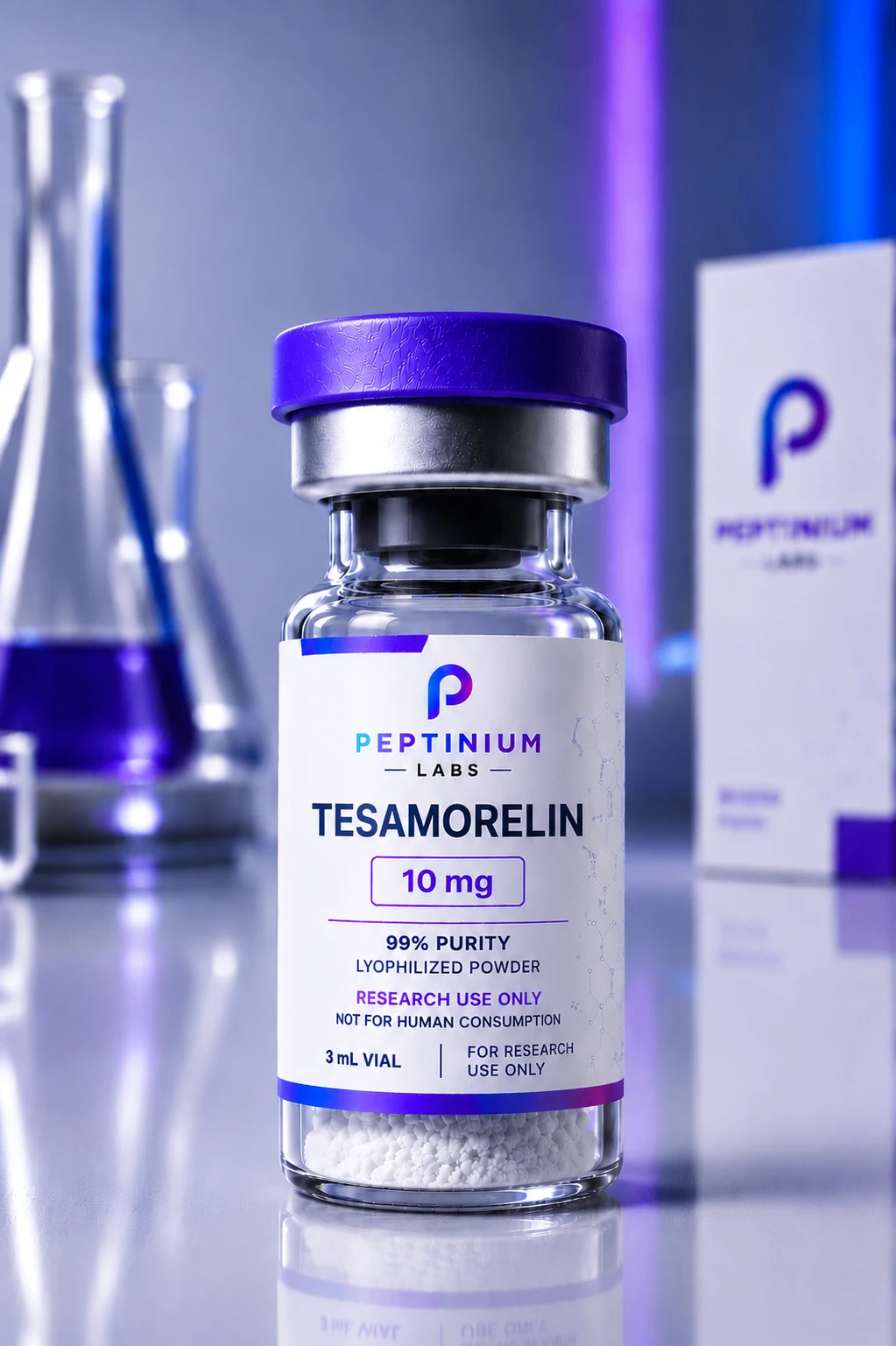
Tesamorelin
Evidence score · 3 ref. PubMed / PMCLyophilized research compound · CAS 218949-48-5
Stabilized GHRH analog — reference tool for in vitro characterization of the GHRH-R receptor.
Not intended for veterinary, diagnostic or therapeutic use. No indication for in vivo use. To be handled exclusively by qualified personnel.
- CAS No.
- 218949-48-5
- Molecular weight
- 5135.8 g/mol
- Molecular formula
- C221H366N72O67S
Effects documented in the literature
Tesamorelin is a stabilized analog of human GHRH (1-44) protected against DPP-IV degradation by an N-terminal trans-3-hexenoyl group. Studies (PMID 20554713, PMID 18690162, JAMA fullarticle/1889139) showed that Tesamorelin binds to the GHRH-R receptor of pituitary somatotropic cells, activating the Gαs → cAMP → PKA pathway and stimulating physiological pulsatile release of endogenous GH. Downstream, hepatic IGF-1 increases. At the body level, clinical work (HIV population with lipodystrophy) documented a selective and significant reduction in visceral adipose tissue (−18% over 26 weeks), without loss of subcutaneous tissue or major effect on blood glucose or insulin sensitivity. The studies also describe a favorable modulation of lipid markers (decreased triglycerides). These data come from the scientific literature and are provided strictly for informational purposes in a research context. This product is not intended for veterinary, diagnostic or therapeutic use and is not recommended for any use outside a scientific, professional and research setting. [1][2][3]
Background, storage, reconstitution
- Research background
- Synthetic peptide used as a pharmacological tool for in vitro study of GHRH-R signaling on pituitary cell lines.
- Storage
- Lyophilized: −20 °C. Reconstituted: 2–8 °C.
- Reconstitution (lab)
- Sterile bacteriostatic water.→ Dilution calculator
PubMed references
- View on PubMed →[1] PubMedPMID 22050344
- View on PMC →[2] PMCPMC9947601
- View on PubMed →[3] PubMedPMID 41545261
What our customers say
No review yet for this product.
Leave a review
Sign in to your account to leave a review.
Sign in