
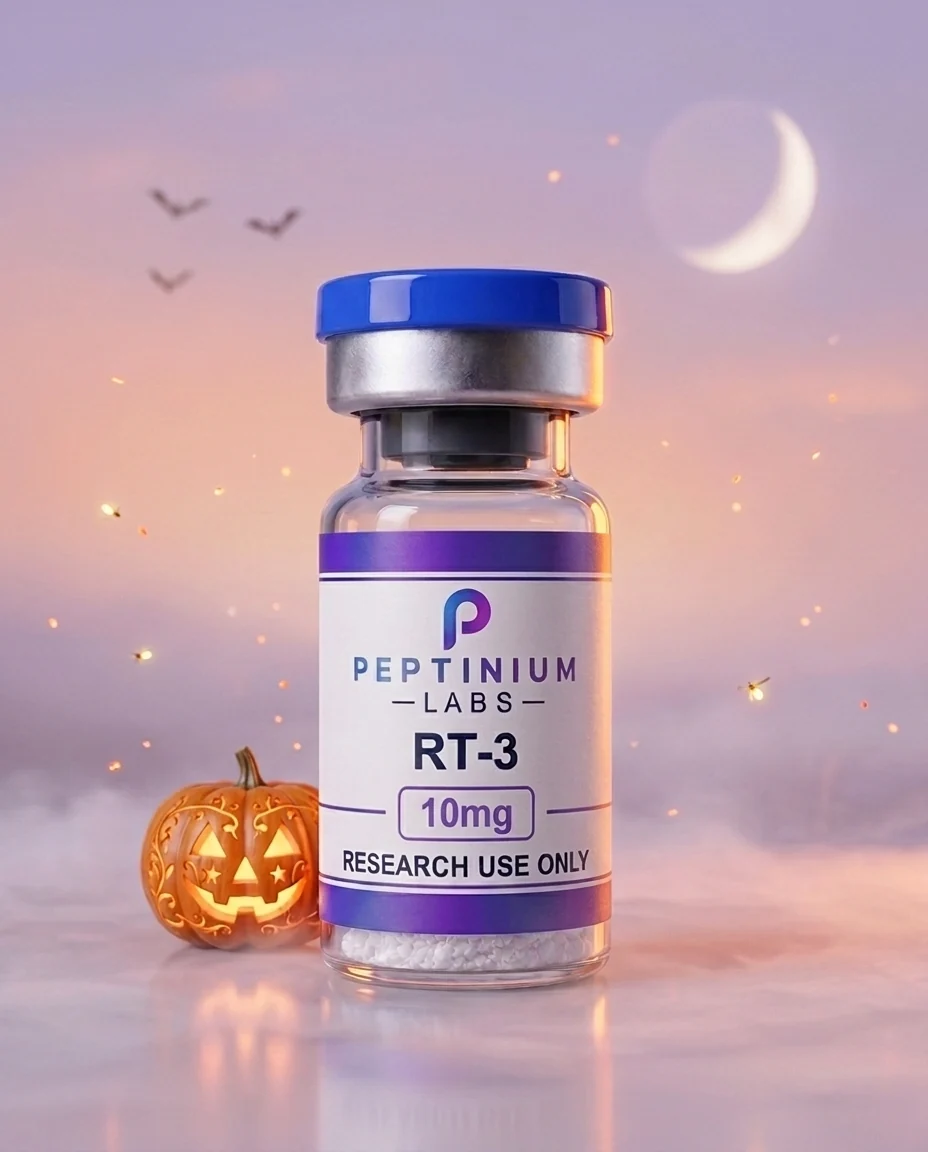
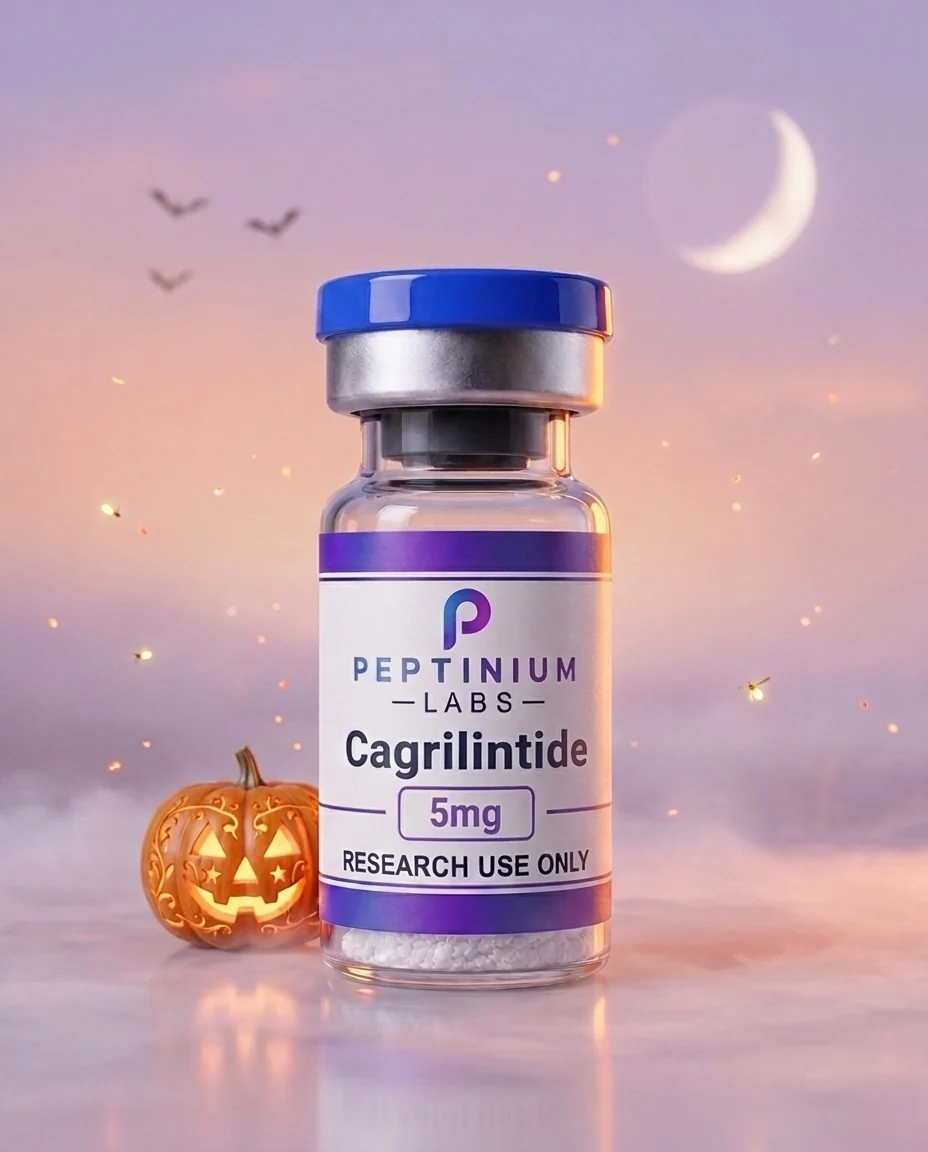
Cap colour may vary by batch.
For research use only
Cagrilintide
Long-acting acylated amylin analog — reference tool for in vitro study of AMY1-3R receptors and the calcitonin receptor.
DosagePurity ≥ 99.0% (HPLC)
€119.00per 5 mg vial
i.e. €23.80 per mg
QuantityHalloween 2 + 1
3 vials: the cheapest item is free at checkout. Estimate for this product alone; the discount is applied at payment, across your whole cart.
Complete your orderOptional
In stock
Shipped within 24 business hours from France, in neutral packaging.
Free shipping from €249. Minimum order €80; delivery options and fees shown on the payment page.
Card, Apple Pay or crypto (USDC, USDT, Bitcoin).

Halloween: 2 + 1 free sitewide · buy 3 items, the cheapest one is free.
Buy 3 items and the cheapest one is free: peptides, packs, pens or accessories, everything counts, and each unit counts as one item. 6 items = 2 free, 9 = 3 free (3 maximum per order). Offer not combinable with promo codes, applied automatically at checkout. Until 31 October inclusive.
A question about this product?
Research Use Only — Laboratory use exclusively. Not intended for veterinary, diagnostic or therapeutic use. No indication for in vivo use. To be handled exclusively by qualified personnel.
Literature
What the literature describes
Cagrilintide is a long-acting analog of human amylin, stabilized by substitution of aggregation-prone residues and by acylation of a C20 diacid chain enabling reversible binding to serum albumin. Published work (PMID 34288673, PMID 37364590) describes non-selective activation of calcitonin receptor (CTR) complexes associated with RAMP1-3, forming the AMY1R, AMY2R, and AMY3R receptors, with Gαs → adenylate cyclase → cAMP coupling and prolonged signaling linked to slow receptor dissociation. In cellular and preclinical models, the literature (PMID 32634450) documents activation of neurons in the area postrema and nucleus tractus solitarius, as well as modulation of hypothalamic POMC/CART pathways. Its signalling pathway, that of amylin, is distinct from the incretin pathway of GLP-1 agonists: it is used as a tool to compare both pathways in research. These data come from the scientific literature and are provided strictly for informational purposes in a research context. This product is not intended for veterinary, diagnostic or therapeutic use and is not recommended for any use outside a scientific, professional and research setting. [1][2][3]
- Research background
- Synthetic analog of human amylin used as a pharmacological tool for in vitro characterization of amylin (AMY1-3R) and calcitonin (CTR) receptor signaling.
- Reconstitution (lab)
- Sterile bacteriostatic water — mix gently, do not shake. Dilution calculator
Chemical identity
What the vial contains
Reference data for the compound. Measured values appear on the Janoshik certificate, when published.
- Research name
- Cagrilintide
- CAS No.
- 1415456-99-3
- Molecular formula
- C194H304N54O61
- Molecular weight
- 4381.9 g/mol
- Specified purity
- ≥ 99.0% (HPLC)
- Vial content
- 5 mg
- Storage
- Lyophilized: refrigerated (2–8 °C) from receipt, protected from light, or at −20 °C for long-term storage; it tolerates a few days of shipping at room temperature with no expected degradation. Reconstituted: refrigerated (2–8 °C).
- Database
- PubChem
Independent analysis
Certificate for 5 mg
No Janoshik certificate has been published for 5 mg yet. We never show another dosage's report in its place.
No certificate published for this dosage
Questions
Frequently asked questions
What does a vial of Cagrilintide contain?
Each vial contains lyophilised Cagrilintide, available in 5 mg. Purity ≥ 99.0% (HPLC), tested by an independent laboratory.
How should Cagrilintide be stored?
Lyophilized: refrigerated (2–8 °C) from receipt, protected from light, or at −20 °C for long-term storage; it tolerates a few days of shipping at room temperature with no expected degradation. Reconstituted: refrigerated (2–8 °C).
How is Cagrilintide reconstituted in the laboratory?
Sterile bacteriostatic water — mix gently, do not shake. The site's dilution calculator helps prepare the desired concentration.
Is Cagrilintide intended for human use?
No. Cagrilintide is a research reagent (RUO) intended exclusively for in vitro laboratory research. It is not intended for human or veterinary use, nor for diagnosing, preventing or treating any disease.
References
Cited sources
- [1]PubMedPMID 34288673PubMed · 34288673View on PubMed
- [2]PubMedPMID 32634450PubMed · 32634450View on PubMed
- [3]PubMedPMID 37364590PubMed · 37364590View on PubMed
Blog
Related guides
Cagrilintide: what the literature says about this long-acting amylin analogAn acylated, stabilized analog of human amylin, cagrilintide is studied for its non-selective activation of AMY receptors and for its half-life of about 7 days reported in the literature.Read the articleRT-3: a synthesis of the research literature on the triple GLP-1/GIP/glucagon agonistA triple GLP-1/GIP/glucagon agonist still in phase 3 clinical trials: editorial synthesis of what the published pharmacological literature documents on RT-3.Read the articleResearch peptides in France: the 2026 guideRUO framework, choosing a supplier, HPLC purity, Janoshik certificates of analysis, storage and reconstitution: the essentials on research peptides in France.Read the article
Same family
Related products
Customer reviews
What our customers say
No review yet for this product.
Leave a review
Sign in to your account to leave a review.
Sign in